Idea Bank — Request for Climate Startups
Recycled Glass Panels
Crush urban waste glass and recast it into premium interior partition tiles and wall panels.
The ask
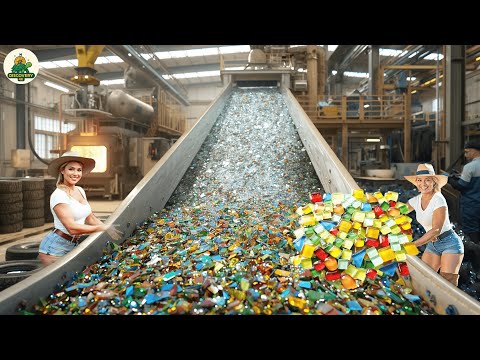
Set up a glass recycling and casting workshop in Dhaka that collects post-consumer glass — bottles, flat glass offcuts, and glazing waste from the construction boom — and hot-processes it into decorative partition panels, backlit wall tiles, and terrazzo-style floor insets sold to interior designers and commercial fit-out projects.
Why now
Dhaka's construction fit-out market is growing rapidly as commercial towers, hotel chains, and upper-mid residential projects compete on interior finish. Architects are increasingly specifying recycled and "story" materials — glass with a visible recycled texture commands a 30–60% premium over equivalent ceramic tiles. Meanwhile, glass recovery in Bangladesh is near zero: most cullet is exported to India at $30–50/tonne or landfilled. The raw material is essentially free.
Why Bangladesh
Dhaka generates an estimated 150–200 tonnes of glass waste per week from the restaurant, hotel, and construction sectors alone. There is no domestic flat-glass recycling facility; all cullet exits the country. A small electric kiln operation (৳30–50 lakh setup) can process 2–3 tonnes per week into finished panels at 10–20x the cullet commodity value. The target buyer is Dhaka's growing interior fit-out economy — a market worth ~৳800 crore annually and almost entirely served by imported tile and glass products.
As a business
Revenue is B2B to interior designers, fit-out contractors, and hotel FF&E buyers (৳4,000–12,000 per sq ft of finished panel, depending on complexity). A secondary stream is supplying crushed glass aggregate to terrazzo flooring contractors at ৳6,000–10,000/tonne. Margins are highest on bespoke architectural commissions; the terrazzo aggregate line keeps the kiln utilised between commissions.
Economics
Move the sliders to model your own glass panel workshop. Defaults are order-of-magnitude estimates — pressure-testing them is part of what a founder pitches us.
Model a recycled glass panel workshop
Clears its setup cost after ~1 months, then profit (volt) from there. Hover or tap the chart for any month.
Illustrative model — defaults are order-of-magnitude estimates from public data, not a forecast. Pressure-test every number before you build.
What AimHuge would back
A design-literate founder who can sell the material as an aesthetic choice, not a sustainability obligation — the buyer is an interior designer, not a CSR officer. We'd back someone who brings a portfolio of architectural relationships and a willingness to do the first ten projects as custom commissions before codifying a standard product range.
Impact
Dhaka's estimated 150–200 tonnes/week of waste glass currently exports at $30–50/tonne as cullet or ends up in landfill; casting it into decorative panels at ৳6,500/sq ft captures 100× more value domestically while completely eliminating the import of equivalent ceramic or stone tiles. A 800 sq ft/month workshop substitutes roughly 2.4 tonnes/month of imported materials — around $3,000/month in FX — and avoids the ~0.8 t CO₂e that would be emitted making virgin ceramic tiles from the same area. Scaling to a 10-workshop industry could process 250 tonnes/year of Dhaka's glass stream and generate 100+ skilled artisan jobs in the fit-out sector.
Also being built elsewhere
Companies proving the model in other markets.
Decorative resin panels with 98–100% recycled glass aggregate, sold to architects and interior designers — proves the premium commercial channel for recycled glass surfaces.
Specification-grade recycled glass panels and tiles for countertops, facades, and partitions — demonstrates architect-spec sales route applicable to Dhaka's commercial fit-out boom.
High-end recycled glass countertops with up to 99% post-consumer content — shows the artisan-to-luxury positioning that commands the ৳6,500+/sq ft price point.
More Circular Materials ideas
Other climate businesses we want built.