Idea Bank — Request for Climate Startups
HDPE Bottle Cap Recycling
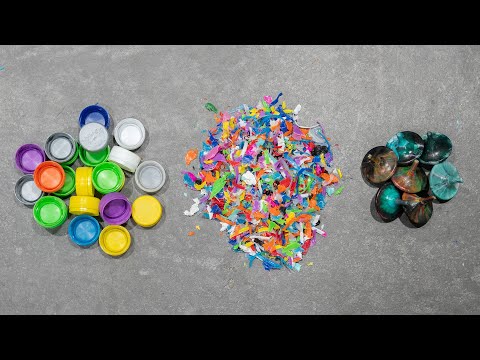
Collect and sort colourful HDPE bottle caps, melt into panels and everyday products.
The ask
Build a community-scale collection and manufacturing network that turns discarded HDPE bottle caps into colourful pressed panels, tiles, and small products — sold to interior designers, schools, and exporters as recycled plastic craft material.
Why now
Precious Plastic (Netherlands) demonstrated that a sub-৳5 lakh injection moulder or sheet press is sufficient to run a profitable micro-factory; dozens of franchises now operate across Africa and Southeast Asia. Rising demand for recycled-content products from export-facing Bangladeshi manufacturers (garments, footwear) is creating a pull market for certified-recycled plastic inputs. Bottle caps are largely unrecycled because they mix resin types — sorting by colour signals high material value and commands a premium.
Why Bangladesh
Dhaka generates an estimated 6,500 tonnes of plastic waste per day, a large fraction of which is HDPE caps from water and beverage bottles. The dense urban fabric makes community collection routes efficient — a single collector can gather 50–80 kg per day within a few blocks. Bangladesh's active informal recycling sector provides a ready workforce; this business formalises and upgrades existing livelihoods rather than displacing them.
As a business
The unit sells sorted caps to its own small press shop at ৳40–60/kg (versus ৳15–20 paid to collectors), then sells finished panels at ৳1,500–3,500 per sheet — a 5–10× material uplift. Franchising the press kit to other micro-entrepreneurs (equipment + training + brand + offtake guarantee) creates a scalable asset-light growth path beyond the first factory. Export to lifestyle brands in Europe and the Gulf is the long-run margin expansion lever.
Economics
Move the sliders to model your own bottle-cap micro-factory. Defaults are order-of-magnitude estimates — pressure-testing them is part of what a founder pitches us.
Model an HDPE cap recycling micro-factory
Clears its setup cost after ~2 months, then profit (volt) from there. Hover or tap the chart for any month.
Illustrative model — defaults are order-of-magnitude estimates from public data, not a forecast. Pressure-test every number before you build.
What AimHuge would back
A founder with a taste for both community enterprise and product design — someone who can run tight collection logistics in dense Dhaka neighbourhoods and simultaneously sell colourful panels to architects and export buyers. A working press shop with three months of sales data and a named offtake partner would make a compelling seed pitch.
Impact
A single micro-factory processing 80 kg/day diverts 24 tonnes/year of HDPE caps from Dhaka's waterways, avoiding roughly 72 t CO₂e/year versus virgin HDPE production (HDPE carries ~3 kg CO₂e/kg avoided). Bangladesh exports garments to buyers with mandatory recycled-content targets from 2026; a certified domestic HDPE supply chain keeps the margin in-country rather than importing rPET from China. At 200 micro-factories across urban Bangladesh — the Precious Plastic franchise model — this is a 5,000-tonne/year diversion that employs 1,000+ urban waste workers.
Also being built elsewhere
Companies proving the model in other markets.
Open-source micro-factory franchise with 600+ active workspaces worldwide — the direct blueprint for a Bangladesh bottle-cap network.
Kigali-based recycled bottle-cap tile manufacturer serving luxury interior markets — shows the premium positioning available in emerging-market cities.
ISO-certified HDPE/LDPE/PP recycler demonstrating formal certification routes that Bangladeshi buyers will require for export compliance.
More Circular Materials ideas
Other climate businesses we want built.