Idea Bank — Request for Climate Startups
Superadobe Earthbag Shelters
Low-cost, flood-resilient earthbag homes built from local soil for Bangladesh's climate-exposed delta.
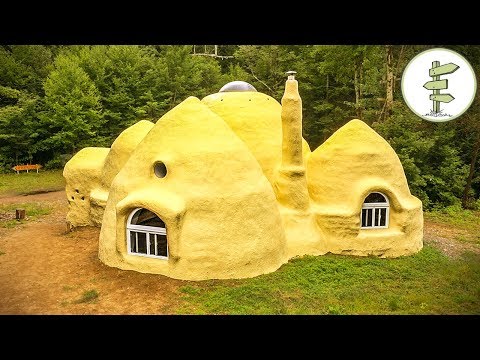
The ask
Build a construction company that trains local crews to erect superadobe (earthbag) structures — using polypropylene bags filled with on-site soil — as permanent or semi-permanent housing for flood-affected, low-income communities and as emergency shelters after cyclones.
Why now
CalEarth and other practitioners have demonstrated superadobe's structural performance in seismic and flood contexts; the technique has UN-Habitat endorsement. Bangladesh's 2022–24 flood and cyclone seasons displaced over 5 million people, accelerating government interest in disaster-resilient construction alternatives. Fired-brick production — the current default for rural housing — consumes 4–6 million tonnes of topsoil and emits 8 million tonnes of CO₂ annually in Bangladesh alone; any viable substitute attracts policy support.
Why Bangladesh
The delta's alluvial soil is ideal earthbag fill — cohesive, clay-rich, and abundant on every construction site. Polypropylene bags are cheap and widely available as a byproduct of the rice and fertiliser trade. Labor costs are low enough that the technique's labor-intensity is a feature, not a bug: a trained four-person crew can erect a 20m² shell in three days. Chittagong Hill Tracts and haor basin communities face annual flooding that renders conventional construction economically absurd — superadobe's flood tolerance (dome geometry, no mortar joints) is structurally suited.
As a business
Revenue comes from three channels: construction contracts with NGOs and government housing programmes (per-unit pricing at ৳80,000–120,000 for a 25m² shell, vs. ৳180,000+ for brick equivalent); training-and-licensing fees to local builders and government extension workers; and carbon credits from avoided brick kiln emissions registered under a Programme of Activities. The construction business generates cash; training and carbon credits are the margin.
Economics
Move the sliders to model your own superadobe construction business. Defaults are order-of-magnitude estimates — pressure-testing them is part of what a founder pitches us.
Model a superadobe construction business
Clears its setup cost after ~5 months, then profit (volt) from there. Hover or tap the chart for any month.
Illustrative model — defaults are order-of-magnitude estimates from public data, not a forecast. Pressure-test every number before you build.
What AimHuge would back
A builder — not an architect — who has already erected a demonstration structure in Bangladesh and can show photos of it surviving a monsoon. AimHuge would fund scale-up of a proven crew model into a franchised training network, not a prototype phase.
Impact
A superadobe 25 m² shell uses ≈12,000 kg of on-site soil fill and ≈400 kg of polypropylene bag material, displacing fired brick entirely; each unit avoids roughly 1.8 tCO₂e versus a conventional brick shell. Building 120 units/year avoids ≈216 tCO₂e/yr, with most of the carbon benefit coming from kiln avoidance. The technique is deliberately labour-intensive — a four-person crew constitutes 3 FTE per unit-month, creating non-farm employment in flood-affected districts where construction is a primary livelihood. Because there is no cement foundation and minimal material import, FX exposure is near zero per unit.
Also being built elsewhere
Companies proving the model in other markets.
Non-profit founded by Nader Khalili that developed Superadobe and has trained builders across 49 countries; the foundational IP and training model the Bangladesh venture would adapt.
Invented Hyperadobe — the mesh-tube variant better suited to humid climates — proving the technique's adaptability to tropical conditions closest to Bangladesh's.
More Low-Carbon Construction ideas
Other climate businesses we want built.