Idea Bank — Request for Climate Startups
Cob 3D Printing
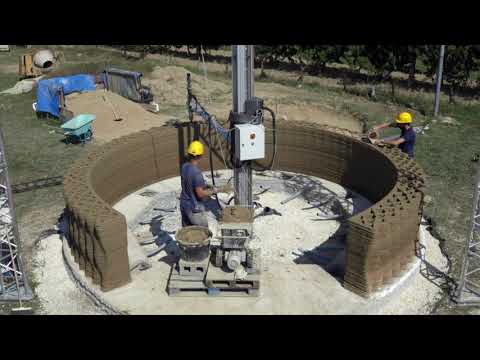
Gantry 3D printer adapted for cob and earth-paste extrusion — rapid low-cost earthen housing.
The ask
Adapt a standard gantry-style construction 3D printer for cob and stabilised earth-paste extrusion, then deploy it as a housing construction service in Bangladesh — targeting rural affordable housing, disaster-reconstruction programmes, and climate-resilient school construction.
Why now
Construction 3D printing has matured rapidly: COBOD, Mighty Buildings, and others have printed multi-storey structures, and open-source gantry designs (like WASP's BigDelta) have cut prototype costs below ৳40 lakh. Earth printing — cob, adobe, and rammed-earth mixtures — has been validated at small scale by research groups in Europe, Australia, and Mexico, demonstrating that local soil with modest stabilisation (5–10% lime or cement) can be extruded reliably. Bangladesh's post-flood reconstruction demand creates a recurring large-scale deployment opportunity that justifies the development investment.
Why Bangladesh
Bangladesh needs roughly 1.5 million new affordable housing units by 2030 (government estimate); conventional construction cannot close that gap at current labour and material costs. River delta soil — predominantly fine-grained silt and clay — is ideal for earth printing with minimal amendment. Cyclone and flood reconstruction cycles (happening every 2–3 years in coastal districts) create predictable government procurement opportunities. Eliminating fired brick (currently 55% of Bangladesh's construction emissions) from one housing type alone would be a significant climate win.
As a business
Operate as a construction service bureau: charge per square metre of printed wall, undercutting conventional masonry on labour-heavy projects while commanding a premium for speed and climate-resilience certification. Revenue from government reconstruction contracts (RRDA, LGED) and NGO housing programmes is the base; private rural construction and eco-resort builds add margin. Equipment leasing to other contractors scales volume without proportional operational headcount.
Economics
Move the sliders to model a cob 3D printing business. Defaults are order-of-magnitude estimates — pressure-testing them is part of what a founder pitches us.
Model a cob 3D printing construction service
Clears its setup cost after ~8 months, then profit (volt) from there. Hover or tap the chart for any month.
Illustrative model — defaults are order-of-magnitude estimates from public data, not a forecast. Pressure-test every number before you build.
What AimHuge would back
A civil or mechanical engineer who has physically printed a structure — even a small shelter — with locally sourced Bangladesh soil. The materials science (getting the right soil-to-binder ratio for consistent extrusion in humid conditions) is the hardest unsolved problem, and we need to see that it is solved before backing a construction-service pitch. A partnership with BUET's civil engineering department for materials testing would be a strong signal.
Impact
Earth 3D printing eliminates fired brick from the wall system entirely; replacing a conventional 25 m² brick-and-mortar shell (≈3.5 tCO₂e embodied carbon) with a printed earth wall reduces embodied emissions by 80–90%, saving roughly 3 tCO₂e per housing unit. At 600 sqm/month printed (≈25 housing-unit equivalents/yr), one machine avoids ≈75 tCO₂e/yr while employing 3–5 operators and material handlers directly. Post-flood reconstruction demand means a local fleet of printers can scale rapidly on government procurement, displacing both imported construction equipment and imported cement.
Also being built elsewhere
Companies proving the model in other markets.
Pioneer in earth-paste 3D printing with the Crane WASP; built the TECLA house entirely from raw earth — the closest technical precedent for tropical cob printing.
Market-leading gantry printer deployed across 30+ countries; proves the construction-as-a-service model and rapid deployment for disaster-reconstruction contracts.
More Low-Carbon Construction ideas
Other climate businesses we want built.