Idea Bank — Request for Climate Startups
Compressed Earth Blocks
Press local laterite soil with minimal cement into stabilised blocks, cutting fired-brick emissions.
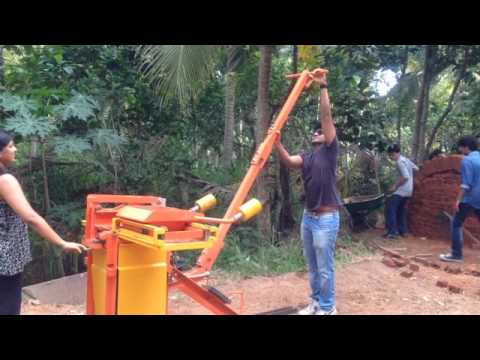
The ask
Manufacture and sell Compressed Stabilised Earth Blocks (CSEBs) — made from locally dug laterite soil mixed with 5–8% Portland cement and mechanically pressed — as a lower-carbon, lower-cost substitute for traditional fired clay bricks in rural and peri-urban Bangladesh construction.
Why now
Bangladesh's brick kilns are one of the country's largest air-pollution sources (roughly 8,000 kilns burning coal and biomass) and face tightening emission regulations from the DoE. Fired-brick prices have risen 40% in three years as fuel costs climbed. CSEB technology is well-proven in South and Southeast Asia; the pressing machines are available from Indian and Chinese suppliers for ৳8–20 lakh, making the startup bar genuinely low.
Why Bangladesh
Bangladesh's Barind tract and hilly Chittagong Hill Tracts sit on laterite deposits that are chemically ideal for CSEB stabilisation — low clay-swell minerals, natural reddish iron content that signals good binding. Rural housing demand is structural: the government's Ashrayan (shelter) programme targets 100,000 homes per cycle and is actively looking for lower-cost, lower-carbon brick alternatives. CSEBs also eliminate the kiln-firing step, reducing embodied carbon by roughly 70% versus fired brick.
As a business
The plant is local by design — soil is sourced within 5 km of the press, eliminating long-haul transport. Blocks sell at ৳8–11 each versus ৳10–14 for fired brick, competing on price while carrying a green-building narrative for NGO and donor-funded housing projects. A franchise model — selling the press machine plus soil-testing service plus the AimHuge-certified CSEB brand to rural entrepreneurs — scales coverage without concentrating risk.
Economics
Move the sliders to model your own CSEB plant. Defaults are order-of-magnitude estimates — pressure-testing them is part of what a founder pitches us.
Model a compressed earth block plant
Clears its setup cost after ~18 months, then profit (volt) from there. Hover or tap the chart for any month.
Illustrative model — defaults are order-of-magnitude estimates from public data, not a forecast. Pressure-test every number before you build.
What AimHuge would back
A founder who has built a test wall from CSEBs that has passed a monsoon season, and who has a relationship with at least one NGO or government housing programme willing to specify CSEBs in a real project. We are open to funding both manufacturing ventures and the franchise-platform model — the latter would benefit from a founder with prior franchise or rural-distribution experience.
Impact
CSEBs eliminate the kiln-firing step, cutting embodied carbon by ≈70% versus fired clay brick (from ≈0.30 kg to ≈0.09 kg CO₂e per unit). At 2,000 blocks/day × 280 days, one plant avoids roughly 235 tCO₂e/yr — the equivalent of taking 50 cars off the road. Laterite soil is dug within 5 km, displacing both coal (imported) and topsoil loss. A franchise model pushing 100 district-level presses could avoid over 23,000 tCO₂e/yr while creating 400+ rural manufacturing jobs in underemployed areas.
Also being built elsewhere
Companies proving the model in other markets.
36-year institution that developed the Auram Press 3000 CSEB machine, proving the technical and commercial model across South Asia and training practitioners worldwide.
Commercial CSEB manufacturer in Bengaluru demonstrating that a for-profit compressed earth block business can operate alongside NGO housing demand.
More Low-Carbon Construction ideas
Other climate businesses we want built.