Idea Bank — Request for Climate Startups
Earthship Homes Bangladesh
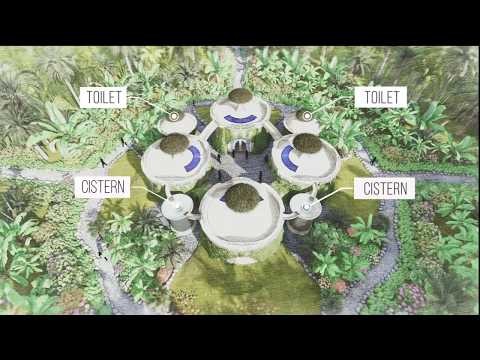
Off-grid homes built from tyres, recycled glass, and rammed earth — self-heating, water-harvesting, net-zero.
The ask
Develop an adapted Earthship construction system for the Bangladesh climate — off-grid homes using waste tyres as thermal mass, rammed earth walls, rainwater harvesting, and passive cooling — and sell to rural landowners, eco-resort developers, and climate-resilient housing programs.
Why now
Bangladesh's waste tyre crisis is acute: an estimated 15–20 million waste tyres accumulate annually with no formal processing industry; tyre-derived thermal mass walls convert a disposal liability into building material. The government's Ashrayan housing program for climate-displaced people is an active procurement channel for low-cost durable housing. Rising flood frequency is creating demand for elevated, resilient construction that conventional brick cannot cheaply deliver.
Why Bangladesh
The classic Earthship design from New Mexico relies on passive solar heating — directly inapplicable in Bangladesh's tropical climate. However, the core innovations (tyre thermal mass for cooling stabilisation, rainwater capture, grey-water cycling) are directly relevant to Bangladesh's 40°C+ summers and monsoon flooding. An adapted design replacing passive heating with passive cooling and flood-elevation would be genuinely new intellectual property, not a copy.
As a business
Revenue from build contracts for private landowners (eco-resorts, rural tourism operators, affluent climate-conscious buyers) at a premium over conventional construction; secondary from licensing the adapted design to NGOs and government housing programs at a lower margin but higher volume. The tyre sourcing is a positive cash contribution — tyre collectors currently pay for disposal, meaning the builder can collect gate fees.
Economics
Move the sliders to model your own Earthship construction business. Defaults are order-of-magnitude estimates — pressure-testing them is part of what a founder pitches us.
Model an Earthship construction business
Clears its setup cost after ~6 months, then profit (volt) from there. Hover or tap the chart for any month.
Illustrative model — defaults are order-of-magnitude estimates from public data, not a forecast. Pressure-test every number before you build.
What AimHuge would back
A founder who has completed at least one structurally certified prototype in Bangladesh — the climate adaptation from desert Earthship to tropical variant is non-trivial and we will not fund a concept. We would want to see a rainwater harvesting system that survives monsoon flooding and a wall assembly that resists high humidity degradation, documented with at least one monsoon cycle of performance data.
Impact
Each adapted Earthship home diverts approximately 250 waste tyres from open burning (which releases 3 kg CO₂e per tyre) and eliminates the embodied carbon of roughly 8 tonnes of cement that would otherwise be used in a comparable concrete structure — avoiding around 8–9 tCO₂e per completed home. At six homes per year the business prevents roughly 55 tCO₂e annually. The passive cooling design eliminates or dramatically reduces the need for air conditioning, cutting household electricity consumption by an estimated 60–70% compared with a brick-concrete home in the same climate zone — directly lowering grid load and associated fossil-fuel emissions. For climate-displaced households in coastal Bangladesh, a flood-elevated, off-grid-water-capable home extends tenure security, reducing the repeated rebuilding cycle that currently consumes enormous material and carbon resources.
Also being built elsewhere
Companies proving the model in other markets.
Founded by Michael Reynolds; has built emergency shelters after the 2004 tsunami and Haiti earthquake — the proof that the model scales into disaster contexts.
Earthship design-build consultancy offering tropical and humid-climate adaptations; directly relevant to Bangladesh's monsoon conditions.
More Low-Carbon Construction ideas
Other climate businesses we want built.