Idea Bank — Request for Climate Startups
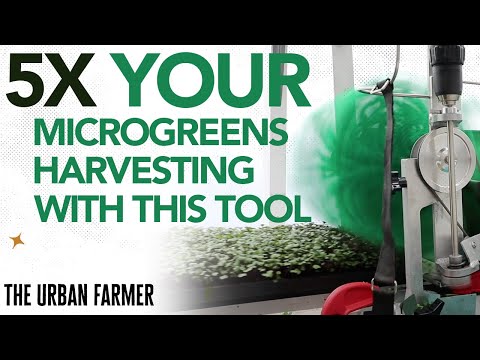
Drill Harvesting Tool
A power-drill attachment that cuts microgreen and leafy-green harvest time by 80%.
The ask
Design, manufacture, and sell a low-cost power-drill harvesting attachment for small urban farms — a spinning blade or comb head that fits a standard cordless drill and cuts harvesting time for microgreens and baby leafy greens from 30–60 minutes per tray to under five minutes.
Why now
Urban farming is growing fast across South and Southeast Asia, but the economics of small-scale operations are pinched by labour: hand-cutting microgreens is slow, fiddly, and the single biggest time cost in a micro-farm's week. A purpose-built harvesting tool for this segment does not yet exist at accessible price points — the commercial Harvester units sold to large vertical farms cost ৳10–25 lakh and assume conveyor-scale volumes. A drill-mount tool manufacturable for under ৳3,000 fills a real gap.
Why Bangladesh
Bangladesh has a rapidly growing urban farming community (largely rooftop) and a manufacturing base — particularly in Dhaka's metalworking and light-engineering clusters in Demra and Tejgaon — that can prototype and produce simple stainless steel tooling cheaply. The same tool exports naturally to India, Thailand, Vietnam, and other markets with booming urban farming scenes. Local production cost advantage over Chinese imports makes this defensible on price.
As a business
The company sells direct to urban farmers and hydroponics supply shops at ৳1,800–3,500 per unit, with a manufacturing cost of ৳400–700 at volume. Sales channels include hydroponics supply distributors, agricultural extension networks, and YouTube/Facebook tutorial marketing targeting the BD urban farming community. A consumables revenue stream — replacement blades, cleaning brushes, tray-size adaptors — builds recurring income. B2B volume sales to commercial urban farms (10+ units at a time) accelerate revenue.
Economics
Move the sliders to model your own drill harvesting tool business. Defaults are order-of-magnitude estimates — pressure-testing them is part of what a founder pitches us.
Model a drill harvesting tool business
Clears its setup cost after ~4 months, then profit (volt) from there. Hover or tap the chart for any month.
Illustrative model — defaults are order-of-magnitude estimates from public data, not a forecast. Pressure-test every number before you build.
What AimHuge would back
This is a product business at heart — we want a founder who can get a working prototype into a urban farmer's hands within 90 days and iterate on the design from real feedback. Manufacturing or industrial design experience is a strong plus. We are open to a founder who simultaneously operates a small urban farm and builds the tool as a solution to their own bottleneck — that combination signals both problem depth and a ready early customer.
Impact
A low-cost drill-mounted microgreens harvester reduces harvesting labour from 30–60 minutes to under 5 minutes per tray, cutting the single biggest operating cost for small urban farms by 80–90 % and making the economics of sub-100 sq m operations viable. At 200 units per month each unit enables roughly 2 tonnes of additional microgreens production per year across the installed base, displacing an equivalent weight of rural-supply greens and the associated truck-transport emissions. The tool is entirely manufactured from domestically-sourced stainless steel, keeping the supply chain local and avoiding the import cost of the US$400–600 Farmer's Friend equivalent that currently must be shipped internationally.
Also being built elsewhere
Companies proving the model in other markets.
More Regenerative Agriculture ideas
Other climate businesses we want built.