Idea Bank — Request for Climate Startups
Solar Cycle-Lane Canopies
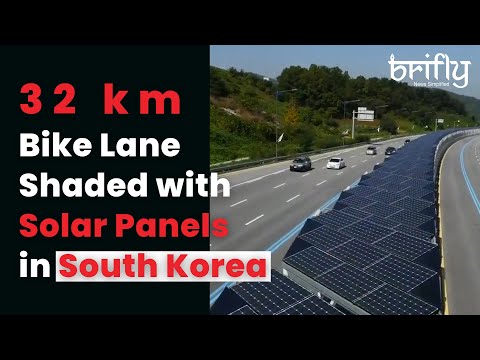
Canopy-mounted solar panels over new BRT cycle lanes generate power and shade riders year-round.
The ask
Install canopy-mounted solar arrays over dedicated cycle lanes on Bangladesh's new BRT and urban road corridors, selling the generated electricity to the road authority or city grid under a power-purchase agreement while providing year-round rain and sun shade to cyclists.
Why now
Canopy solar over bike lanes is structurally superior to embedded road solar — no traction loss, no surface durability problem, higher yield (unobstructed tilt angle), proven in the Netherlands and Seoul. Bangladesh's MRT and BRT expansion (Dhaka MRT-6 opened 2022; MRT-1, MRT-5, multiple BRT lines under construction) is creating kilometres of newly built dedicated corridors where the structural integration is cheapest to add during construction rather than retrofit.
Why Bangladesh
Dhaka's tropical climate makes shade as valuable as electricity to commuters — a covered cycle lane in 38 °C heat has genuine modal-shift value beyond clean energy. BRTA and Dhaka North/South city corporations have stated targets for non-motorised transport infrastructure; canopy solar addresses both the transport and renewable-energy mandates simultaneously. Bangladesh has abundant local structural steel and panel assembly capacity to keep civil costs low.
As a business
The developer bids into road-infrastructure procurement as a design-build-operate partner: AimHuge (or the portfolio company) designs the canopy structure, sources panels, builds, and operates under a 20–25 year concession with electricity revenue shared with the road authority. Development fees, EPC margin, and O&M margin across a 20-year asset life produce an IRR competitive with conventional solar parks at lower land cost.
Economics
Move the sliders to model your own solar cycle-lane canopy project. Defaults are order-of-magnitude estimates — pressure-testing them is part of what a founder pitches us.
Model a solar cycle-lane canopy project
Does not break even within 5 years at these inputs — adjust the sliders. Hover or tap the chart for any month.
Illustrative model — defaults are order-of-magnitude estimates from public data, not a forecast. Pressure-test every number before you build.
What AimHuge would back
An infrastructure-developer founder with civil engineering depth and a relationship inside BRTA or Dhaka city corporations. The investment thesis here is a 20-year cash-flowing concession asset — we will co-develop the first project and syndicate the construction finance. The founder needs to own the procurement relationship and the structural-engineering sign-off.
Impact
A 3 km canopy (9,000 m²) generating 175 kWh/m²/yr produces 1.575 GWh/yr, avoiding roughly 1,230 tCO₂e versus the Bangladesh grid. Unlike embedded road solar, canopy panels are unshaded and tilted, so real-world yields are achievable rather than theoretical. Beyond carbon, the shade and rain cover has demonstrated modal-shift value in Dhaka's 38 °C summers — moving trips from CNG auto-rickshaws to cycles multiplies the effective emissions abatement 3–5x. Each km of canopy built during MRT/BRT construction rather than as a retrofit cuts civil costs by an estimated 30–40%.
Also being built elsewhere
Companies proving the model in other markets.
32 km solar-canopy bike highway between Daejeon and Sejong generating 2,200 MWh/yr — the direct government-built proof of concept for this model.
World's first solar bike path pilot; long-running dataset on yield, maintenance, and public acceptance of solar cycle infrastructure.
More Clean Energy ideas
Other climate businesses we want built.