Idea Bank — Request for Climate Startups
Bio-Battery Research
Organic and microbial electrochemistry for batteries that avoid rare-earth mining.
The ask
Establish a Bangladesh-based research and IP venture that develops biological or bio-inspired battery chemistries — using quinone-based organic redox couples, microbial fuel-cell architectures, or cellulose-derived electrolytes — and licenses the resulting IP to battery manufacturers or spins out a specialty-application product (grid-scale flow batteries, medical devices) where organic chemistry outperforms lithium.
Why now
Lithium-ion's supply-chain bottlenecks (cobalt from DRC, lithium from South America, graphite from China) have pushed government and corporate R&D budgets toward alternatives. ARPA-E, InnoEnergy, and Innovate UK have collectively funded $500M+ in organic battery research since 2020. The science has matured: quinone-based flow batteries from Harvard spinout Quino Energy, and CATL's sodium-ion cells, show commercially viable alternatives are entering the market. Bangladesh has strong chemistry and materials departments at BUET, Dhaka University, and BCSIR — underutilised for applied research.
Why Bangladesh
This is a harder Bangladesh fit than most ideas in this bank — bio-battery research is fundamentally a global technology play. The Bangladesh angle is talent arbitrage: BUET chemistry and materials PhDs cost $12,000–18,000/year versus $90,000+ in the US or Germany, making early-stage research feasible at much lower burn. A Bangladesh-anchored research entity could secure grant funding from GCF, ADB's Climate Innovation Fund, or USAID's Energy Innovation programme — all of which prioritise developing-country institutions — while building IP at fraction of Western cost.
As a business
Revenue model is grant-first, then licensing: early stage is funded by climate R&D grants (GCF, USAID, Bill Gates' Breakthrough Energy) and government research contracts. Year 3–5, the business transitions to IP licensing to battery manufacturers or spins out a product around a specific application (e.g. a low-cost agricultural sensor battery using organic chemistry). This is a 7–10 year venture; the right framing is a deep-tech research company, not a product startup.
Economics
Move the sliders to model your own deep-tech research venture. Defaults are order-of-magnitude estimates — pressure-testing them is part of what a founder pitches us.
Model a bio-battery research venture
Does not break even within 5 years at these inputs — adjust the sliders. Hover or tap the chart for any month.
Illustrative model — defaults are order-of-magnitude estimates from public data, not a forecast. Pressure-test every number before you build.
What AimHuge would back
This is a frontier bet with low Bangladesh fit and a very long time horizon — AimHuge would only back it if a BUET or DU researcher brings genuinely novel preliminary data and a credible path to international grant co-funding. We would not lead this round alone; we'd be a co-investor alongside a development-finance institution. The right founder is a scientist-CEO, not a generalist entrepreneur.
Impact
Successful commercialisation of a quinone-based flow battery chemistry eliminates cobalt and lithium from the bill of materials — removing two supply-chain choke points that otherwise make grid-scale storage dependent on Chinese and DRC commodity markets. A single licensed grid-scale battery product could displace 50,000+ tCO₂e/yr of peaker-plant emissions per GWh of deployed capacity. The Bangladesh angle is talent-cost arbitrage: running the early-stage research at BUET for $150,000–180,000/yr versus $1M+ in the US or EU makes the IP credible and licensable at a fraction of the capital cost, positioning Bangladesh as a node in global climate-tech IP development.
Also being built elsewhere
Companies proving the model in other markets.
Harvard spinout developing quinone-based organic flow batteries; $10M Series A in 2025 — the direct technology comparable and potential licensing partner.
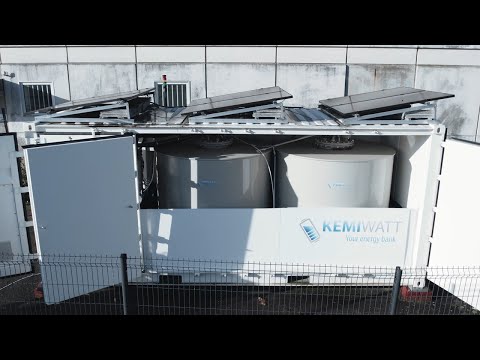
French startup producing organic redox flow batteries from biodegradable molecules — demonstrates that non-US research hubs can compete in organic battery IP.
German organic flow battery company with MW-scale deployments — proof that university chemistry research can reach commercial grid storage within a decade.
More Clean Energy ideas
Other climate businesses we want built.